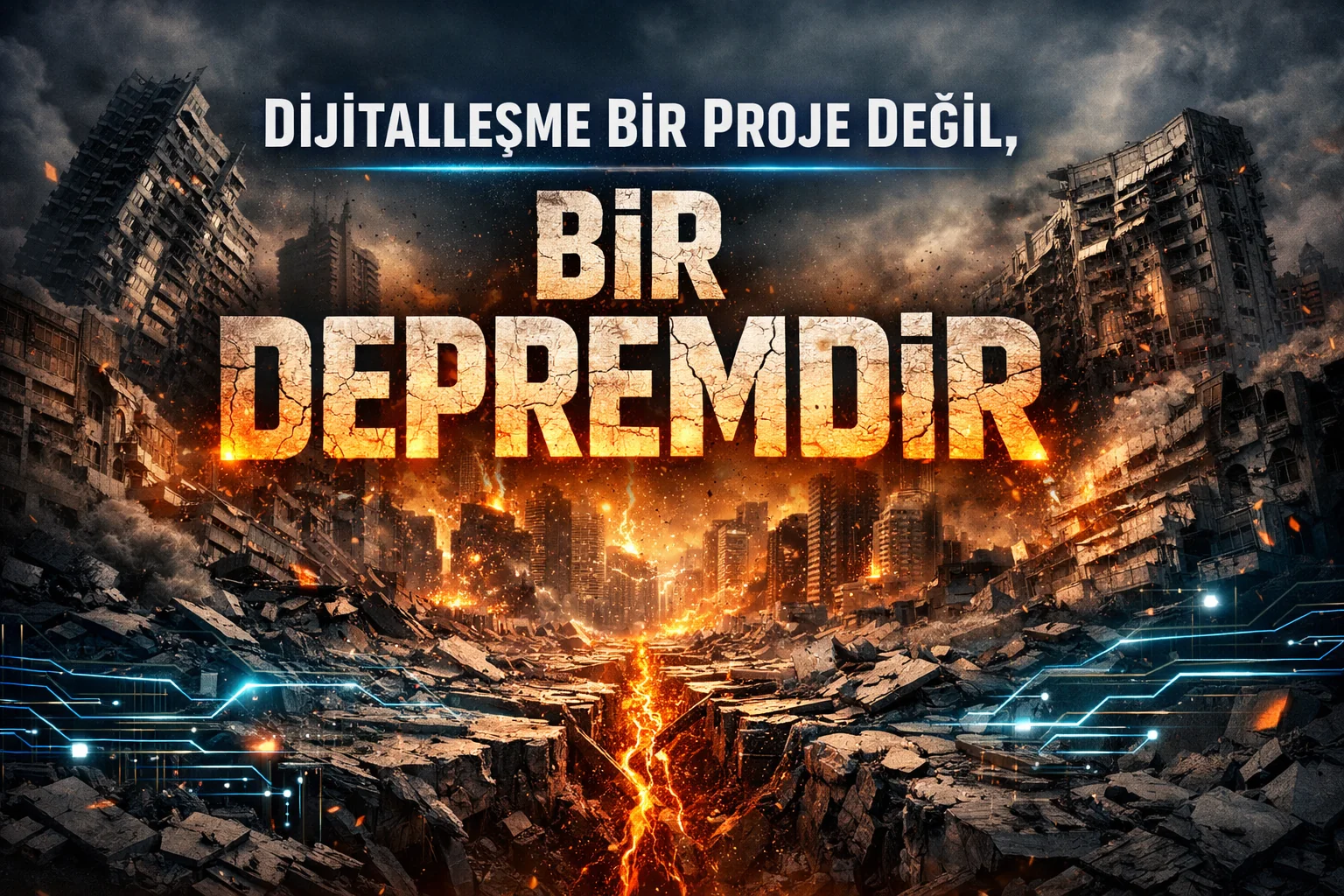
If you are not ready, you will collapse, not the system.
Institutionalism, flexibility, traceability, sustainability… They didn’t show up to fill out consultant presentations. It’s all the result of one simple fact: The business cannot scale as long as it remains dependent on people.
Every digitalization move made without understanding this fact; Whether it is software purchase, product development or CRM/ERP transition… It doesn’t make things easier. Makes existing mess permanent.
The most dangerous misconception is this:
“If we switch to the system, things will get better.”
No. The system doesn’t fix things. The system accelerates whatever you are.
If processes are not clear, chaos uncertainty if the responsibility is unclear, If there is no control, there is no control.
So without really understanding the processes, the question “why does it exist?” Every digitalization initiative started without asking the question ends up in the same place:
if = X müşteri
if = X ürün
buraya özel akış
This reflex, which seems like “flexibility” at first, soon turns into this:
- No one can rule the whole
- The system does not belong to anyone
- Cost is invisible but increases
And after a critical threshold, the return is either non-existent or too expensive for the company to bear.
At this point, it is not technology that is lost. What is lost is control, speed and reliability.
Therefore, this issue is not a technology issue. This is a matter of project management and culture.
Digitalization, software selection, product development, institutionalization… All of these touch the carrier columns of the organization. This is an earthquake. If there is no preparation, wreckage is inevitable.
Two real experiences explain this very clearly.
In the first, a company that conducts all its business with simple tools switches to a system to “institutionalize”. Technically everything is correct: data is migrated, training is provided. But processes are not questioned. It is not clear who owns what. Decision points are not defined.
After a while, the team says: “In the past, at least we could move.”
Today the picture is clear:
- The team is tired
- RPM is high
- Information belongs to people
- No one sees the whole picture
There is system but there is no order. There is chaos but no responsibility.
In the second example, even the smallest job is written, analyzed, planned, tested and revised. The owner of every business is clear. Every decision has a record. Some things don’t work, yes. But it is known why it does not work.
Result: More work with fewer people. It was higher with less work. A structure that can be scaled in more than one country.
The difference is not software. It is discipline.
The answer is actually not surprising. Most of the mistakes made in digitalization projects are repeat and predictable.
Starts without defining clear business purpose. Result: The project drags on, success remains open to debate. Solution: If there is no measurable goal, there is no project.
Digitalization is thought to be an IT job. Result: The system is established, the job remains the same. Solution: Process ownership remains with business units.
Existing processes are migrated without question. Result: Old mistakes become digital. Solution: “Why does this step exist?” If there is no answer to the question, there is no step.
Uncontrolled customization is done under the excuse of “special for us”. Result: The system crashes, costs explode. Solution: Privatization is accepted only if it is a competitive advantage.
Project management is considered secondary. Result: Decisions are delayed, the project drags on. Solution: Single authority, clear decision mechanism.
Time and human resources are underestimated. Result: The team burns out, quality decreases. Solution: Critical roles are actually allocated to the project.
Data quality is left to the end. Result: Wrong report, wrong decision. Solution: Data work starts separately, seriously, and early.
Education is for show. Result: The system is not used, Excel comes back. Solution: Role-based, real-scenario training.
Resistance to change is ignored. Result: Parallel systems, hidden chaos. Solution: “Why do we change?” There will be no transition until the question is clarified.
This is considered a go-live ending. Result: Value quietly melts away. Solution: A post-go-live recovery plan is essential.
That’s why quality, process management and institutionalism exist. This is why concepts such as ISO are misunderstood. What’s on paper doesn’t make anyone bigger. But the real process; makes the work traceable, repeatable and sustainable.This is exactly the difference between a structure without rules and with rules. If there is a system, you can create a big impact with few resources. If there is no system, the moment of growth is the moment of collapse.
Digitalization projects generally do not fail in one day. It quietly spirals out of control. The cost increases, the team disperses, and the system becomes a burden that no one owns.
This article asks “which software?” It was written to remind you of the main question that should be asked before the question:
“How do we do this job?” (and does everyone know it the same way?)