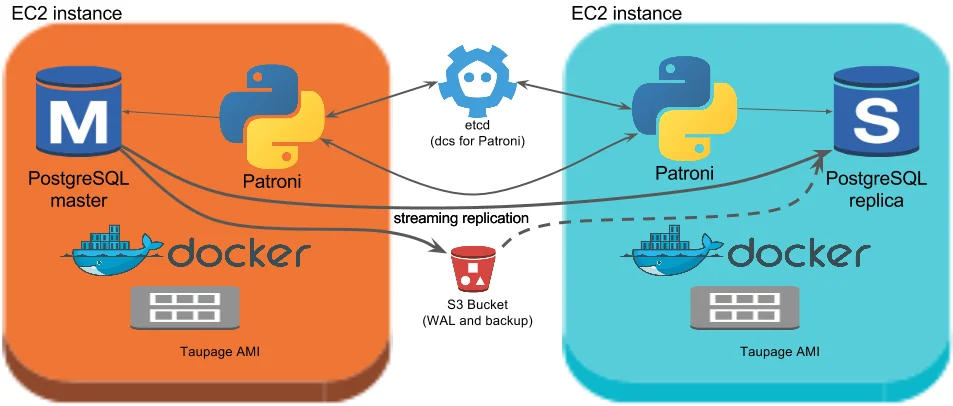
PostgreSQL Cluster Creation: A Powerful Structure with Spilo, Patroni, WAL-G and PSQL
Image taken from Spilo official repository account
PostgreSQL is a database management system known for its durability, wide scalability and high performance. However, configuring a PostgreSQL database to provide high availability (HA) and data security can be quite complex. At this point, tools such as Spilo, Patroni, WAL-G and PSQL come into play and make PostgreSQL cluster installation easier. In this article, we will discuss how these four tools work in harmony and the conveniences they provide us.
Spilo: The Image That Brings PostgreSQL and Patroni Together
Spilo is the Docker image containing PostgreSQL and Patroni. The biggest advantage of Spilo is that it offers pre-configured features such as high availability and automatic failover. By integrating Patroni, Spilo simplifies database replication and failover. Additionally, thanks to Spilo’s flexible structure, you can take advantage of PostgreSQL’s powerful features and customize it according to your needs.
Patroni: Management and Automation for High Availability
Patroni is a HA (high availability) management tool for PostgreSQL. Patroni monitors all nodes in the cluster and automatically appoints another node as the master when a node fails. In this way, the database service continues to operate without interruption. Features offered by Patroni:
- Automatic Failover: When the leader node fails, another node is automatically appointed as the leader.
- Flexibility: Patroni can work with different deployment methods (etcd, Consul, Kubernetes).
- Easy Management: It is easy to monitor and manage cluster status with Patroni’s REST API.
WAL-G: Data Security and Fast Backup
WAL-G is a backup and recovery tool for PostgreSQL. It minimizes data loss, especially by backing up WAL (Write-Ahead Logging) segments. WAL-G offers a faster and more reliable solution compared to traditional backup methods. Advantages provided:
- WAL Backup: Automatically retrieves WAL files and backs them up to the cloud (AWS S3, Google Cloud Storage, etc.).
- Quick Recovery: Can quickly restore the database to a specific point in time.
- Low Cost Backup: Minimizes human errors and reduces operational costs by automating backup processes.
PSQL: Database Management and Querying
PSQL is the command line tool used to manage and query the PostgreSQL database. PSQL is used to run SQL queries, update database configurations, and perform detailed analysis on the database. In addition to the flexibility and power provided by PSQL, its CLI-based nature provides fast and efficient management.
Using These Tools Together: A Powerful and Secure PostgreSQL Cluster
The combined use of these four tools provides high availability, data security and easy management. Here is what this harmony brings to us:
- Easy Installation and Management: Spilo offers PostgreSQL and Patroni pre-configured, simplifying the installation process.
- High Availability: Thanks to Patroni, uninterrupted operation of the database service is ensured.
- Data Security: WAL-G minimizes data loss and offers fast recovery.
- Efficient Management: You can easily manage and analyze the database with PSQL.
Result
PostgreSQL is preferred by many businesses as a high-performance and reliable database management system. However, a PostgreSQL cluster installed without using the right tools may be inadequate in terms of high availability and data security. The combined use of Spilo, Patroni, WAL-G and PSQL meets these needs and provides a powerful and secure PostgreSQL cluster structure. Choosing this structure simplifies database management and also reduces operational costs.These tools allow you to make the most of the powerful features PostgreSQL offers and make database management more reliable and efficient. If you want to increase the continuity and security of your database infrastructure, you can consider setting up a PostgreSQL cluster where these four tools work in harmony.