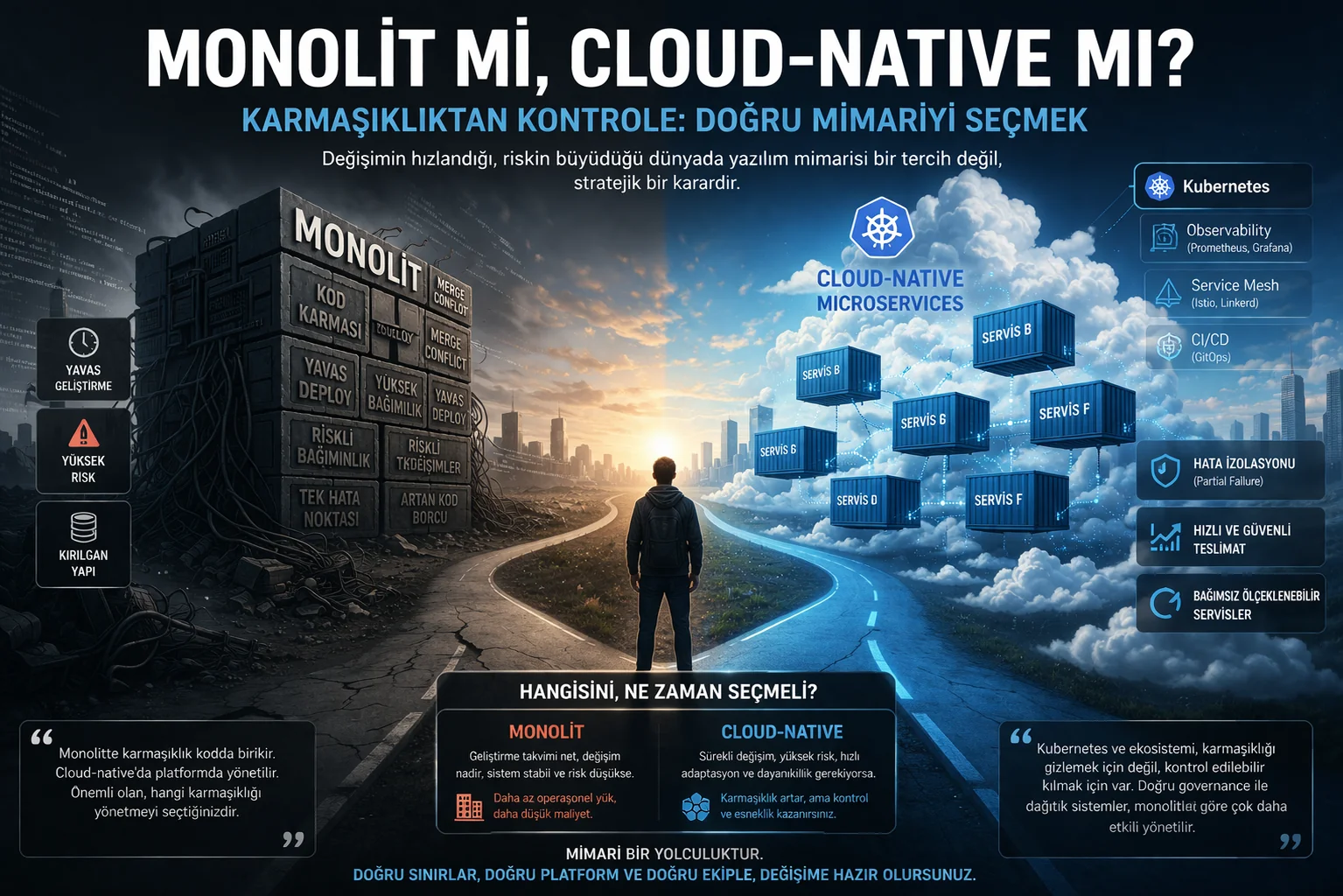
Another concept in our lives is the cloud-native approach. Kubernetes, microservices and containerization now form the basis of many systems. But with this concept a simple question becomes more complex:
Monolith or distributed architecture?
There is no single correct answer to this question. Because it’s not about technology, it’s about what kind of complexity you want to manage where.
Monolith: Simple Start, Increasing Internal Complexity
Everything is clear when you start with a monolith application. There is a single codebase, a single runtime and a central business logic. The code is readable, easy to debug, and the system can be understood in its entirety.
However, as the system grows, this simplicity gives way to a different cost. Teams working on the same code base begin to enter each other’s domain over time. Merge conflicts increase, features conflict, code review processes become heavier, and deep dependency on developers occurs in some areas.
At this point the monolith produces:
An operationally simple but expensive system in terms of team coordination.
Cloud-Native: Resilience, But Distributed Complexity
Cloud-native approach emerges to solve this problem. The system is divided into small parts, runs on Kubernetes, services are deployed independently and different technologies can be used if necessary.
This approach provides serious advantages. You can write a new service instead of forcing the existing system to add a new capability. You can quickly include open-source or SaaS components into the system. You can use resources more efficiently and scale services independently.
However, there is a critical fact here:
Confusion does not disappear, it just changes place.
It exits the code and moves to the platform layer.
The Real Distinction: The Place of Complexity
At this point, the debate is not “monolith or microservice”.
The real question is:
Where do I want to manage complexity?
In a monolith, complexity accumulates within the codebase. In a distributed system, this complexity spreads to the infrastructure, inter-service communication and operation layers.
So both approaches actually optimize one thing while making something else expensive.
Infra is now the App itself
When you build a distributed system, the application is no longer just the code you write.
Kubernetes manifests, deployment pipelines, gateway rules, messaging infrastructure, observability system, config and secret management… all of these become an integral part of the application.
At this point, an important mental break occurs:
Infrastructure is no longer the operations layer, but the runtime architecture of the application.
Why is Distributed Approach Preferred?
One of the strongest motivations for distributed architecture is fault isolation. When correct boundaries are drawn, a service problem does not affect the entire system. The system continues to work partially instead of being completely down.
This approach reduces the impact on the user and makes crises more manageable. However, this benefit cannot be achieved by simply dividing services. Behaviors such as timeout, retry, circuit breaker, queue parsing and idempotency must also be configured correctly.
Otherwise, the system appears distributed, but in terms of behavior, it still collapses as a single piece.
Why Does Tech Stack Grow?
In the cloud-native approach, the growth of the tech stack is not a mistake but a natural consequence. Because a single framework no longer solves every problem. Topics such as logging, tracing, messaging, config and deployment are handled separately.
This makes the system powerful, but also increases the surface area that needs to be learned and managed.
Missing Piece: Platform Governance
Cloud-native approach alone is not enough. If a control mechanism is not added, the system will fall apart in a short time. Each team chooses its own technology, service boundaries are violated, data ownership becomes blurred and debugging becomes difficult.
What emerges at this point is not a modern architecture, but just a more complex system.
The solution is this:
Platform + GovernanceStandards are determined centrally, service boundaries are maintained, contracts are controlled and the system operates within certain rules. But balance is critical here. Excessive control slows down the system, while lack of control produces chaos.
AI Factor
There is another important variable in the new equation: AI.
In large monolithic codebases, AI has a hard time understanding context and is more prone to producing buggy or repetitive code. In distributed structures, small and clear-defined services enable AI to produce more accurately.
This is a significant advantage. However, there is a critical misunderstanding here:
AI makes writing code cheaper, not system administration.
Writing a service becomes easier, but operating, monitoring, securing and maintaining that service is still costly.
Which One Should We Choose When?
At this point, the choice should be made according to the nature of the system, not the technology.
If your system is constantly changing, new releases are released every week, and this process continues for a long time, the monolith will create serious chaos over time. The same codebase constantly changes, dependencies increase and the evolution of the system becomes difficult.
In this scenario, the distributed approach provides a significant advantage. As services are separated, the change impact remains local. In fact, many services continue to operate untouched after a while. The system grows, but not every part has to change at the same rate. This can also fix complexity.
On the other hand, if the application you are developing will be stable at a certain point, will not require constant change, and will be largely completed after a planned development process, a monolith may be a more logical option. Because its operational cost is lower and it does not create unnecessary distribution complexity.
In summary:
- Constant change and evolution → distributed approach
- Stable, limited development → monolith
Result
The main idea of this article is simple:
Monolith and cloud-native are not alternatives to each other, but two approaches that manage different types of complexity.
Successful systems are successful not just because they are distributed, but because they are built with the right boundaries and strong platform governance.
And perhaps the most critical fact is this:
Infra is no longer just the place where the system operates, it is the system itself.
Today, the direction of the major players in the industry is moving in this direction. Kubernetes and the ecosystem that developed around it actually emerged to simplify the complexity in the cloud-native world. There were tools in the monolith world that tried to solve similar problems; Metrics could be produced and traces could be made at a certain level. However, keeping situations such as scale, failover and partial outage under control was limited.
That’s why distributed architecture and microservice approach emerged. But what was missing in the first stage was governance. Today, with organizationally defined governance, complexity becomes more visible, more traceable and more manageable, thanks to Kubernetes and its surrounding tools.
Of course, this approach has a cost. It requires broad tech stack knowledge, a strong platform approach and continuous learning.
As someone who has managed many crises in my own experience, I prefer to pay this cost in systems that are constantly changing and can potentially cause problems. Learning more comes at the expense of progressing more slowly at first; It is more valuable for me to keep the system alive in times of crisis and to minimize user impact.
On the other hand, I do not hesitate to prefer the monolith approach in scenarios where the risk is low and the system will remain stable. Because we don’t have to choose the most complex solution for every problem.
If there is no risk, the easiest solution is often the best solution.