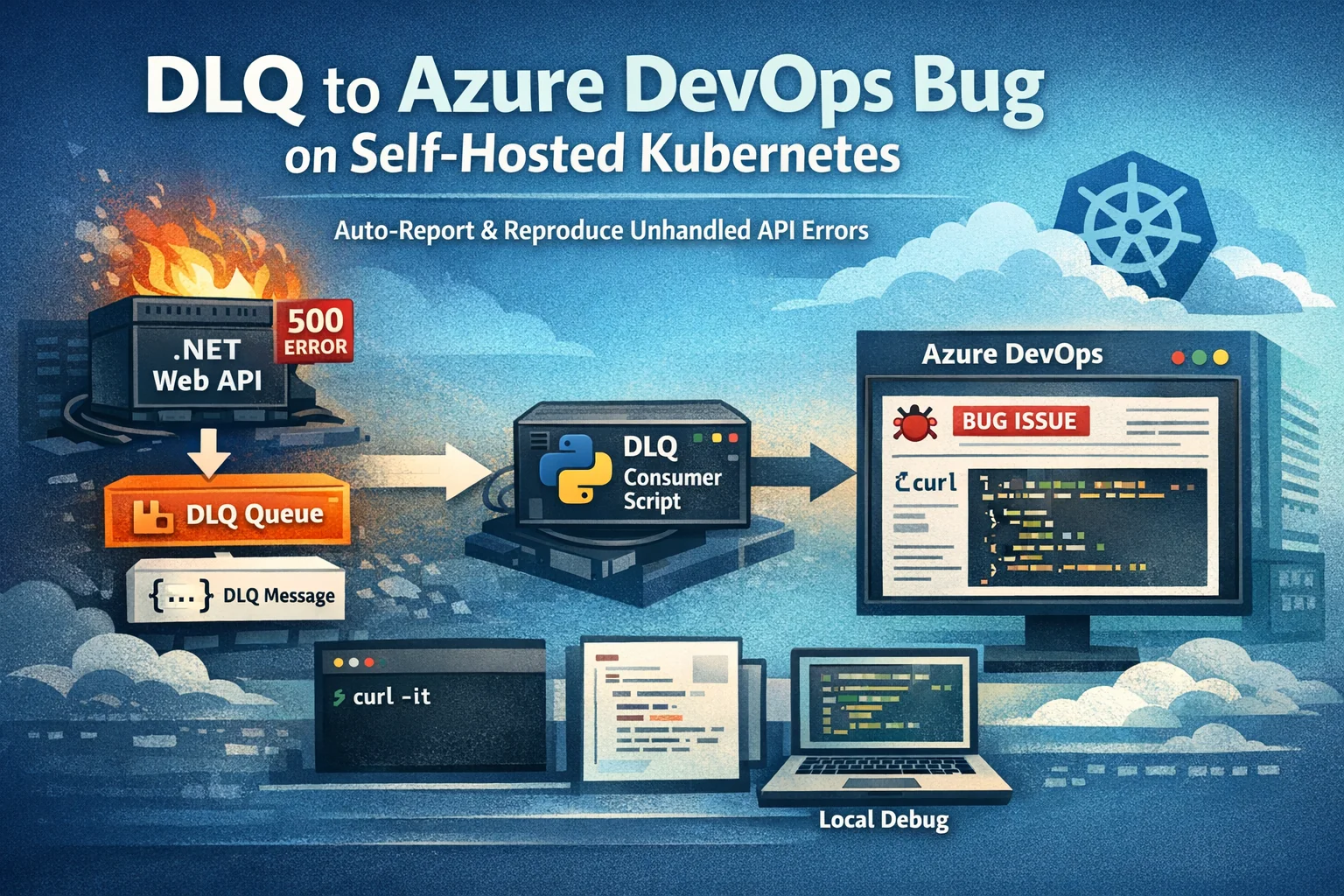
Sometimes it’s not just “500”; If there are 500, its proof, repro and version information should be in one place. My goal is this:
- .NET Web API running on Self-hosted Kubernetes
- User makes a call, Unhandled Exception fires while preparing the response
- The service writes this error to the DLQ queue (I chose RabbitMQ, Kafka/Redis Streams also works)
- DLQ consumer (K8s Deployment) receives message, opens Bug in Azure DevOps
- Bug puts a repro package in it: so that the developer can trigger the same bug locally with this content
In the examples in this article, the main issue is not the word “DLQ”; poison/error event falls into a queue and automatic issue is opened.
1) Topology
2) “Repro Package” that we will put in the Bug
The data that is useful to the developer is as follows:
- traceId / correlationId
- HTTP replay:
- method, path, query
- sanitized headers (no Authorization/Cookie) -request body
- example
curl
- Build fingerprint:
- service name
- version, git sha, image tag
- Runtime fingerprint: -pod/namespace/node
- Exception:
- type, message -stack trace
- inner exceptions
We will embed this package into the bug as “single JSON”.
Warning: We do not knowingly put things like Authorization/Cookie. I don’t want to leak PII/secrets. But I add “required for repro” fields such as tenantId.
3) .NET Web API: Unhandled exception → DLQ queue
3.1 appsettings.json
{
  "Dlq": {
    "RabbitMq": {
      "Host": "rabbitmq",
      "User": "app",
      "Pass": "secret",
      "Queue": "dlq.api-errors"
    }
  },
  "Build": {
    "ServiceName": "orders-api",
    "Version": "1.2.3",
    "GitSha": "abc1234",
    "ImageTag": "orders-api:abc1234"
  }
}
3.2 Middleware: buffer request, generate repro package, push DLQ
I use
EnableBuffering()to read the request body and put it back into the pipeline. This part is “best-effort”; If the body cannot be read, the base packet is still created.
using System.Text;
using System.Text.Json;

public sealed class GlobalExceptionToDlqMiddleware : IMiddleware
{
    private readonly IDlqPublisher _publisher;
    private readonly IConfiguration _cfg;
    private readonly ILogger<GlobalExceptionToDlqMiddleware> _logger;

    public GlobalExceptionToDlqMiddleware(IDlqPublisher publisher, IConfiguration cfg, ILogger<GlobalExceptionToDlqMiddleware> logger)
    {
        _publisher = publisher;
        _cfg = cfg;
        _logger = logger;
    }

    public async Task InvokeAsync(HttpContext context, RequestDelegate next)
    {
        try
        {
            await next(context);
        }
        catch (Exception ex)
        {
            var traceId = context.TraceIdentifier;
            var request = context.Request;

            string requestBody = "";
            try
            {
                request.EnableBuffering();
                using var reader = new StreamReader(request.Body, Encoding.UTF8, leaveOpen: true);
                requestBody = await reader.ReadToEndAsync();
                request.Body.Position = 0;
            }
            catch { /* best-effort */ }

            var headers = request.Headers
                .Where(h => !IsSensitiveHeader(h.Key))
                .ToDictionary(k => k.Key, v => v.Value.ToString());

            // OPTIONAL: tenantId gibi repro için kritik alanlar (header’dan ya da body’den)
            var tenantId = request.Headers.TryGetValue("x-tenant-id", out var t) ? t.ToString() : null;

            var repro = new
            {
                kind = "unhandled_api_error",
                occurredAtUtc = DateTime.UtcNow,
                traceId,

                http = new
                {
                    method = request.Method,
                    path = request.Path.Value,
                    query = request.QueryString.Value,
                    headers,
                    body = requestBody
                },

                context = new
                {
                    tenantId,
                    // userId gibi bir şey koyacaksan hashle
                    // userHash = Hash(context.User.Identity?.Name)
                },

                exception = FlattenException(ex),

                build = new
                {
                    service = _cfg["Build:ServiceName"],
                    version = _cfg["Build:Version"],
                    gitSha = _cfg["Build:GitSha"],
                    imageTag = _cfg["Build:ImageTag"]
                },

                runtime = new
                {
                    pod = Environment.GetEnvironmentVariable("HOSTNAME"),
                    @namespace = Environment.GetEnvironmentVariable("POD_NAMESPACE"),
                    node = Environment.GetEnvironmentVariable("NODE_NAME")
                }
            };

            await _publisher.PublishAsync(repro, traceId);

            _logger.LogError(ex, "Unhandled error. traceId={TraceId}", traceId);

            context.Response.StatusCode = 500;
            await context.Response.WriteAsJsonAsync(new { success = false, code = "ERR-UNHANDLED", traceId });
        }
    }

    private static bool IsSensitiveHeader(string key)
    {
        var k = key.ToLowerInvariant();
        return k is "authorization" or "cookie" or "set-cookie" or "x-api-key";
    }

    private static object FlattenException(Exception ex)
    {
        var list = new List<object>();
        Exception? cur = ex;
        while (cur != null)
        {
            list.Add(new
            {
                type = cur.GetType().FullName,
                message = cur.Message,
                stack = cur.StackTrace
            });
            cur = cur.InnerException;
        }
        return list;
    }
}
3.3 DLQ publisher (RabbitMQ)
NuGet: RabbitMQ.Client
public interface IDlqPublisher
{
    Task PublishAsync(object payload, string correlationId);
}
using System.Text;
using System.Text.Json;
using RabbitMQ.Client;

public sealed class RabbitDlqPublisher : IDlqPublisher
{
    private readonly IConnection _conn;
    private readonly string _queue;

    public RabbitDlqPublisher(IConfiguration cfg)
    {
        _queue = cfg["Dlq:RabbitMq:Queue"]!;
        var factory = new ConnectionFactory
        {
            HostName = cfg["Dlq:RabbitMq:Host"],
            UserName = cfg["Dlq:RabbitMq:User"],
            Password = cfg["Dlq:RabbitMq:Pass"]
        };
        _conn = factory.CreateConnection();
    }

    public Task PublishAsync(object payload, string correlationId)
    {
        using var ch = _conn.CreateModel();
        ch.QueueDeclare(_queue, durable: true, exclusive: false, autoDelete: false);

        var props = ch.CreateBasicProperties();
        props.Persistent = true;
        props.CorrelationId = correlationId;
        props.ContentType = "application/json";

        var bytes = Encoding.UTF8.GetBytes(JsonSerializer.Serialize(payload));
        ch.BasicPublish(exchange: "", routingKey: _queue, basicProperties: props, body: bytes);
        return Task.CompletedTask;
    }
}
3.4 Program.cs binding
var builder = WebApplication.CreateBuilder(args);

builder.Services.AddControllers();

builder.Services.AddSingleton<IDlqPublisher, RabbitDlqPublisher>();
builder.Services.AddTransient<GlobalExceptionToDlqMiddleware>();

var app = builder.Build();

app.UseMiddleware<GlobalExceptionToDlqMiddleware>();
app.MapControllers();

app.Run();
4) Test endpoint: generate intentional error (for demo)
[ApiController]
[Route("api/test")]
public class TestController : ControllerBase
{
    [HttpPost("explode")]
    public IActionResult Explode([FromBody] object payload)
    {
        // "response hazırlanırken patladı" senaryosu
        throw new InvalidOperationException("Simulated unhandled exception for DLQ demo.");
    }
}
5) DLQ Consumer: Works on self-hosted K8s, causes bugs
This consumer:
- Listens to
dlq.api-errorsfrom RabbitMQ - Parses the message
- Opens Bug with Azure DevOps REST API
-
In the bug description:
curl- full JSON payload
- build/runtime/exception puts
- then ack
5.1 Python code
Pip: pika requests
import os, json, base64, requests
import pika
RABBIT_HOST = os.environ["RABBIT_HOST"]
RABBIT_USER = os.environ["RABBIT_USER"]
RABBIT_PASS = os.environ["RABBIT_PASS"]
QUEUE = os.environ.get("DLQ_QUEUE", "dlq.api-errors")
AZDO_ORG = os.environ["AZDO_ORG"]
AZDO_PROJECT = os.environ["AZDO_PROJECT"]
AZDO_PAT = os.environ["AZDO_PAT"]
def escape_html(s: str) -> str:
return (s.replace("&", "&").replace("<", "<").replace(">", ">"))
def build_curl(payload: dict) -> str:
http = payload.get("http", {})
method = http.get("method", "POST")
path = http.get("path", "/")
query = http.get("query", "")
headers = http.get("headers", {})
body = http.get("body", "")
header_lines = []
for k, v in headers.items():
# Assume sanitized already
header_lines.append(f"-H '{k}: {v}'")
curl = (
f"curl -i -X {method} \\\n"
f" 'http://localhost:8080{path}{query}' \\\n"
f" " + " \\\n ".join(header_lines) + " \\\n"
f" --data-raw '{body}'"
)
return curl
def azdo_create_bug(title: str, description_html: str):
url = f"https://dev.azure.com/{AZDO_ORG}/{AZDO_PROJECT}/_apis/wit/workitems/$Bug?api-version=7.1-preview.3"
token = base64.b64encode(f":{AZDO_PAT}".encode()).decode()
headers = {
"Authorization": f"Basic {token}",
"Content-Type": "application/json-patch+json"
}
patch = [
{"op": "add", "path": "/fields/System.Title", "value": title},
{"op": "add", "path": "/fields/System.Description", "value": description_html},
]
r = requests.post(url, headers=headers, data=json.dumps(patch), timeout=20)
r.raise_for_status()
return r.json()
def build_description(payload: dict) -> str:
trace_id = payload.get("traceId", "-")
build = payload.get("build", {})
runtime = payload.get("runtime", {})
exc = payload.get("exception", [])
curl = build_curl(payload)
pretty_json = json.dumps(payload, indent=2, ensure_ascii=False)
# Exception summary (first item)
exc_summary = ""
if isinstance(exc, list) and len(exc) > 0:
e0 = exc[0]
exc_summary = f"{e0.get('type','Exception')}: {e0.get('message','')}"
else:
exc_summary = "Exception: -"
html = f"""
<h3>DLQ Repro Package</h3>
<p><b>TraceId:</b> {escape_html(str(trace_id))}</p>
<p><b>Exception:</b> {escape_html(exc_summary)}</p>
<h4>Build Fingerprint</h4>
<pre>{escape_html(json.dumps(build, indent=2, ensure_ascii=False))}</pre>
<h4>Runtime Fingerprint</h4>
<pre>{escape_html(json.dumps(runtime, indent=2, ensure_ascii=False))}</pre>
<h4>Replay (Local)</h4>
<p>API'yı localde 8080'de ayağa kaldırıp aşağıdaki curl'ü çalıştır.</p>
<pre>{escape_html(curl)}</pre>
<h4>Full Payload (JSON)</h4>
<pre>{escape_html(pretty_json)}</pre>
"""
return html
def on_message(ch, method, properties, body_bytes):
try:
payload = json.loads(body_bytes.decode("utf-8"))
trace_id = payload.get("traceId") or properties.correlation_id or "-"
service = (payload.get("build") or {}).get("service", "service")
title = f"[DLQ] Unhandled API Error | {service} | traceId={trace_id}"
desc = build_description(payload)
azdo_create_bug(title, desc)
ch.basic_ack(delivery_tag=method.delivery_tag)
except Exception as e:
# no ack -> retry later
print("ERROR:", str(e))
def main():
creds = pika.PlainCredentials(RABBIT_USER, RABBIT_PASS)
conn = pika.BlockingConnection(pika.ConnectionParameters(host=RABBIT_HOST, credentials=creds))
ch = conn.channel()
ch.queue_declare(queue=QUEUE, durable=True)
ch.basic_qos(prefetch_count=5)
ch.basic_consume(queue=QUEUE, on_message_callback=on_message)
print("dlq-consumer started.")
ch.start_consuming()
if __name__ == "__main__":
main()
6) Kubernetes manifest examples
6.1 Orders API Deployment (fingerprint with downward API)
apiVersion: apps/v1
kind: Deployment
metadata:
  name: orders-api
  namespace: demo
spec:
  replicas: 2
  selector:
    matchLabels:
      app: orders-api
  template:
    metadata:
      labels:
        app: orders-api
    spec:
      containers:
      - name: orders-api
        image: registry.local/orders-api:abc1234
        ports:
        - containerPort: 8080
        env:
        - name: POD_NAMESPACE
          valueFrom:
            fieldRef: { fieldPath: metadata.namespace }
        - name: NODE_NAME
          valueFrom:
            fieldRef: { fieldPath: spec.nodeName }
        # Rabbit settings (demo; prod’da Secret kullan)
        - name: Dlq__RabbitMq__Host
          value: rabbitmq.demo.svc.cluster.local
        - name: Dlq__RabbitMq__User
          value: app
        - name: Dlq__RabbitMq__Pass
          value: secret
        - name: Dlq__RabbitMq__Queue
          value: dlq.api-errors
6.2 dlq-consumer Deployment
apiVersion: apps/v1
kind: Deployment
metadata:
  name: dlq-consumer
  namespace: demo
spec:
  replicas: 1
  selector:
    matchLabels:
      app: dlq-consumer
  template:
    metadata:
      labels:
        app: dlq-consumer
    spec:
      containers:
      - name: dlq-consumer
        image: registry.local/dlq-consumer:1.0.0
        env:
        - name: RABBIT_HOST
          value: rabbitmq.demo.svc.cluster.local
        - name: RABBIT_USER
          value: app
        - name: RABBIT_PASS
          value: secret
        - name: DLQ_QUEUE
          value: dlq.api-errors
        - name: AZDO_ORG
          value: yourOrg
        - name: AZDO_PROJECT
          value: yourProject
        - name: AZDO_PAT
          valueFrom:
            secretKeyRef:
              name: azdo-pat
              key: pat
7) Simulating “same error” locally
When the bug opens, the description already contains the following:
- Full JSON payload
- Replay curl
Developer’s practice:
- Launch the API locally
- Run
curlon Bug - The same code path is triggered with the same request body + the same route.
- Walks through log/trace with
traceId
That’s it.
8) Criticism from the field: where does this system explode?
Not without writing this:
-
Duplicate bug spam: The same message can be processed again when the consumer is restarted.
- Solution: extract the hash of the payload, put it in the bug title, first search in ADO or dedupe with Redis/SQL.
-
PII/Secrets: There may be customer data in the body.
- Solution: field based mask (email, taxId, iban, address).
-
Error storm: when a config explodes, hundreds of bugs pop up.
- Solution: “signature” based aggregation (single bug for the same stack+route, occurrence count/comment).
If it were me, I would put a “minimum” solution to these three before going to prod, otherwise the system would DDoS itself.
9) Last wordWhat I like about this approach: it does not carry the “error occurred” information, but a error reproducible package.
When you open the bug, it’s not “look at the logs”; You say, “Take this curl, here’s the payload, here’s the imageTag.”
In short: error = event. Don’t lose the event. Convert event to issue. Fill issue with repro.